Reading a Union Anniversary Beyond the Ceremony
Reading a union anniversary closely shows how its program connects a shared institution to public memory, and which histories its ceremony leaves harder to hear.
What does a union anniversary ask you to remember, and whose account does its program make easiest to hear? Reading a union anniversary closely means examining the choices behind the ceremony: which beginnings are named, which institutions receive attention, and how the occasion connects a shared political past to civic memory.
A public anniversary is not a neutral container for history. A parade route, museum display, school lesson, or official speech gives some parts of the past a clear place and leaves others in the background. That does not make the celebration false. It makes its framing worth noticing.
Start with one anniversary program, whether it belongs to a federation, a political union, or another shared civic institution. The useful question is not whether the occasion delivers a complete history. It is how it turns an origin story into a public account of the institution and its members.
Read the anniversary program as a public record
Gather the official schedule, speeches, museum or archive pages, school materials, local event notices, and coverage from different communities. Note who produced each item and whom it appears intended to reach. Keep the materials together so that claims made in one setting can be compared with the choices made in another.
Record recurring terms such as “founding,” “unity,” “partnership,” or “shared future.” Then list the concrete subjects attached to those words: perhaps a treaty, a constitutional agreement, negotiations among communities, a movement for self-government, or the creation of a public institution. Specific references make broad civic language easier to assess.
A commemorative program is like a family photo album: what it includes can matter, but the frame does not show everyone who was in the room. The point is not to treat every omission as evidence of intent. It is to notice how selection shapes the public story.
Follow the order of events the program presents
Make a simple sequence of the events the anniversary names. Record where the account starts, which turning points it includes, and where it stops. Beginning with a formal agreement can tell a different story from beginning with earlier negotiations or the political histories of the communities involved.
Notice what the program treats as a cause and what it presents as a consequence. Are people described as participants, negotiators, subjects, or spectators? Does the account explain why a shared institution was formed, or move quickly from its founding to present-day benefits?
A ceremony has limited room; it need not become a complete history course. The relevant distinction is between a selective account that makes its limits apparent and one that presents its chosen sequence as the whole story.
Look at the people, places, and institutions placed in view
Examine the speakers, named groups, images, and venues. Ask whose voices appear in official remarks and whose experiences are reduced to a general reference. A community might be named as a partner, for instance, or folded into an undifferentiated public.
Consider whether the program acknowledges communities affected by the union’s formation, people who opposed particular terms, and groups whose political claims did not fit the official account. Their absence does not by itself establish deliberate exclusion. It does show the boundaries of the story being told.
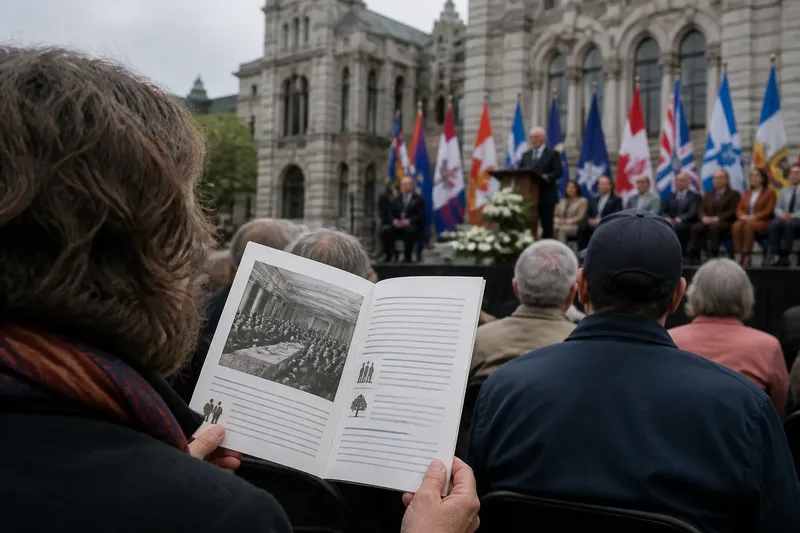
The venue also gives the occasion a civic setting. A national chamber, regional town square, or community hall places the anniversary among different institutions and audiences. The location cannot settle the meaning, but it can show whom organizers have placed at the center of the event.
Compare historical accounts on specific points
Read accounts from groups that describe the shared political history differently. Community archives, civic organizations, public museums, and local historical societies can offer useful material when their authorship and purpose are clear. Compare their accounts with the official program without assuming that every source is trying to answer the same question.
Say an anniversary program calls a union a negotiated partnership, while a community archive emphasizes that its members had little influence over the terms. The specific difference is not just a choice of tone: “partnership” may describe the formal structure of an agreement while leaving participation and consent unresolved. Recording that distinction keeps the comparison precise.
When accounts conflict, state the disagreement plainly. Is it about who initiated the union, what choices were available, whether an agreement was voluntary, or how its consequences are remembered? A named disagreement is more informative than a vague appeal to complexity, which can function as a polite curtain.
Identify the civic purpose of the occasion
Look at what the event asks its audience to do. It may invite reflection, celebrate an institution, teach a shared civic story, recognize a difficult past, or encourage participation in public life. Several purposes can coexist, though one may dominate the program.
Distinguish remembering an event from endorsing every consequence associated with it. A ceremony can honor cooperation while making room for historical questions. Another might present unity as proof that earlier disputes have been settled. The language, speakers, and activities help reveal which approach the program takes.
Pay attention to the expected response. If the program asks for pride but provides little account of conflict, pride is its main invitation. Testimony, local histories, or public discussion may instead ask the audience to connect attachment to the institution with a fuller account of its past.
Which details clarify an anniversary’s historical account?
Where does the anniversary story begin?
Check whether the account starts with a formal founding moment, earlier negotiations, or a community’s prior political history. The starting point can make some relationships visible while making others seem incidental.
Does the program separate agreement from universal approval?
A union can be formed through an agreement without every community or individual supporting it. Look for wording that distinguishes the existence of an agreement from claims about who accepted it.
How does the program make room for different historical accounts?
Check whether alternative accounts appear in the official event, in separate local programs, or only in outside materials. Their placement can show whether the anniversary treats them as part of its public record or as a separate subject.
What does the program invite people to remember afterward?
Look for follow-up activities, public resources, or future commemorations. These details show whether the occasion points toward continued attention to the institution’s history or confines remembrance to the anniversary itself.
Use a concrete comparison to make the reading specific
Imagine you are reading an invented anniversary program that opens with the signing of a constitutional agreement, features a speech about shared institutions, and lists no community archive or local history. You also have an invented community archive page that describes earlier negotiations and questions who influenced the agreement’s terms.
First, write down the program’s starting point and the events it omits from its sequence. Next, record how it uses “shared institutions,” then compare that phrase with the archive’s account of participation. Finally, check whether the official schedule gives the archive or community historians a place. The resulting observation is specific: the program presents the agreement and its institutions, while the archive foregrounds negotiation and influence; the official event does not visibly connect those accounts. That is a description of the materials, not a claim about the organizers’ motives.
Record what the program emphasizes and what it leaves unclear
When reviewing the materials, use each observation to decide what to check next. If the result points to an unanswered question, take the alternative action rather than treating an absence as proof of intent.
- Check the first event named; if the account begins with a formal founding, then compare it with earlier negotiations, and if those are already included, then note how the program connects them.
- Check which communities are named as participants; if some appear only as a general public, then look for a community-authored account, and if they are named directly, then examine what roles the program assigns them.
- Check whether speeches distinguish agreement from approval; if they treat signing as universal consent, then compare the claim with accounts of participation, and if they make the distinction, then record how they explain it.
- Check which institutions appear in the program; if only national institutions are named, then inspect regional or local materials, and if several levels appear, then note how their roles are related.
- Check whether the event identifies disagreement about the union’s formation; if it does not, then search the cited public resources for the disputed point, and if it does, then record whose account is presented.
- Check where alternative histories appear; if they are absent from the official event, then compare separate community programs, and if they are included, then note whether the program gives them context or only a brief mention.
Keep observations separate from conclusions about why organizers made particular choices. Then describe how the accounts share the occasion: in the same speech, across separate events, or only in materials beyond the official program. Those distinctions show how a public anniversary arranges a union’s history and gives its members a place within that account.
Reading a union anniversary closely need not produce a verdict on the union as a whole. It can show how a public ritual links an origin story to civic memory, and which parts of that link remain difficult to see. The schedule, venue, and chosen sources are not incidental paperwork; together, they are the practical record of what the occasion makes available for remembrance.